Why AI Visibility Is an Engineering Problem, Not a Marketing Problem
#AIVisibility #AnswerEngineOptimization #AEO #AIOverviews #ChatGPT #GoogleAI

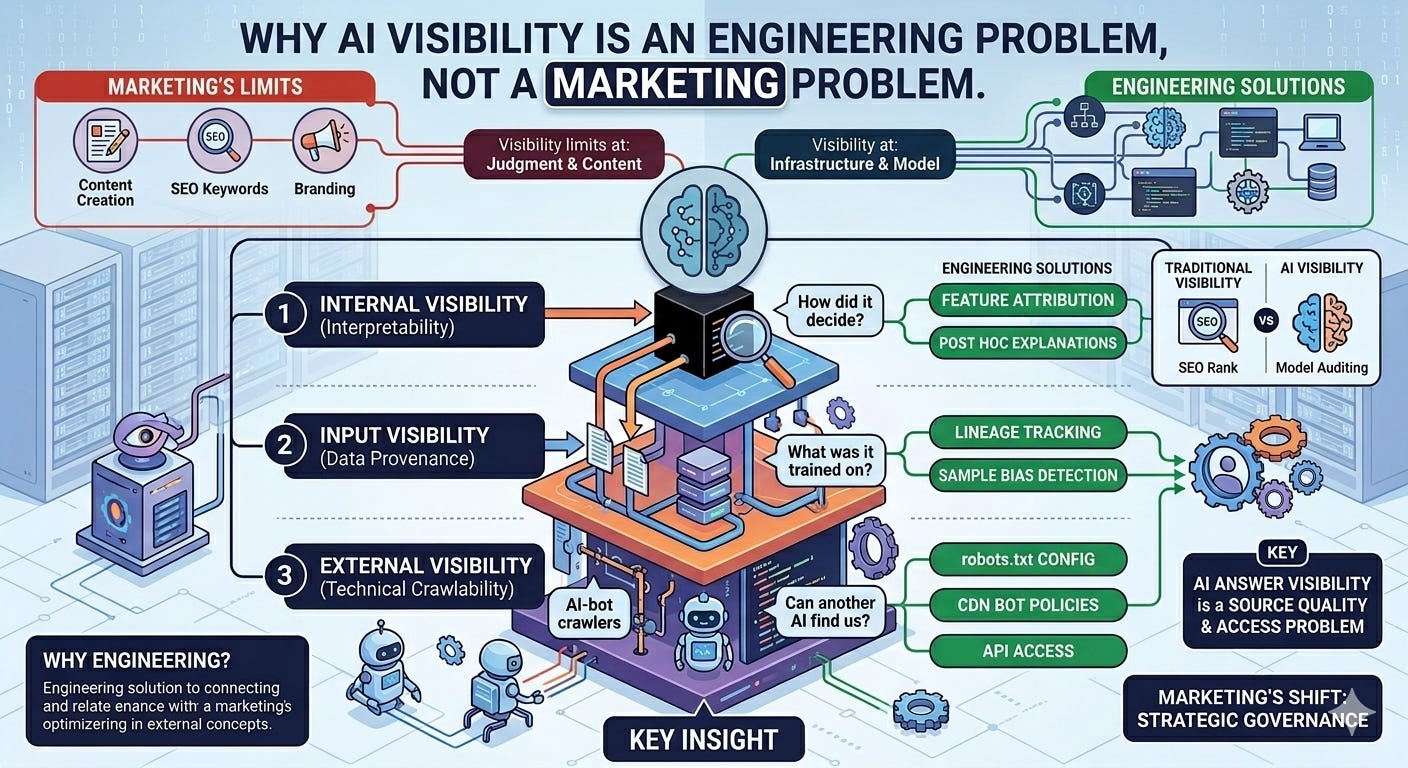
This morning I ran four searches.
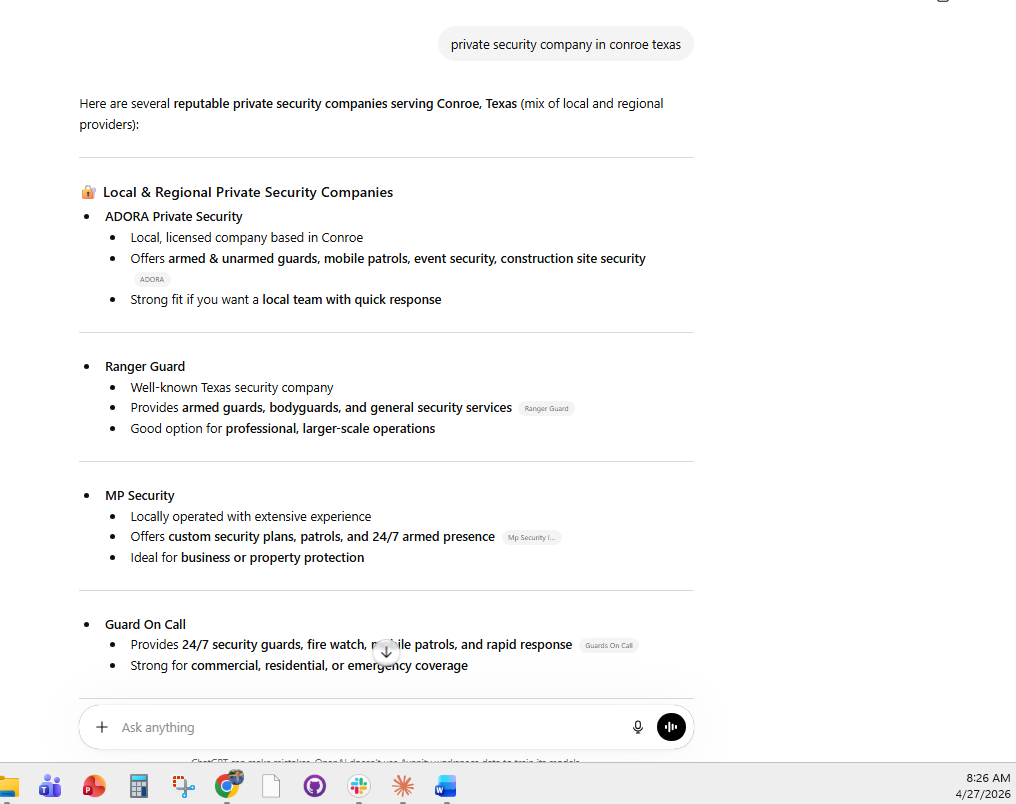
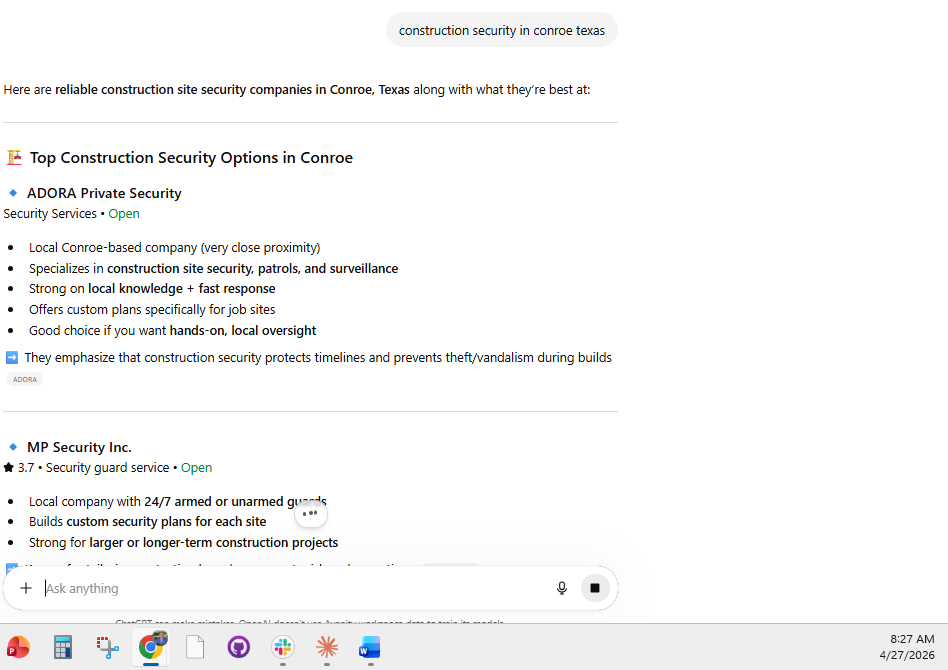
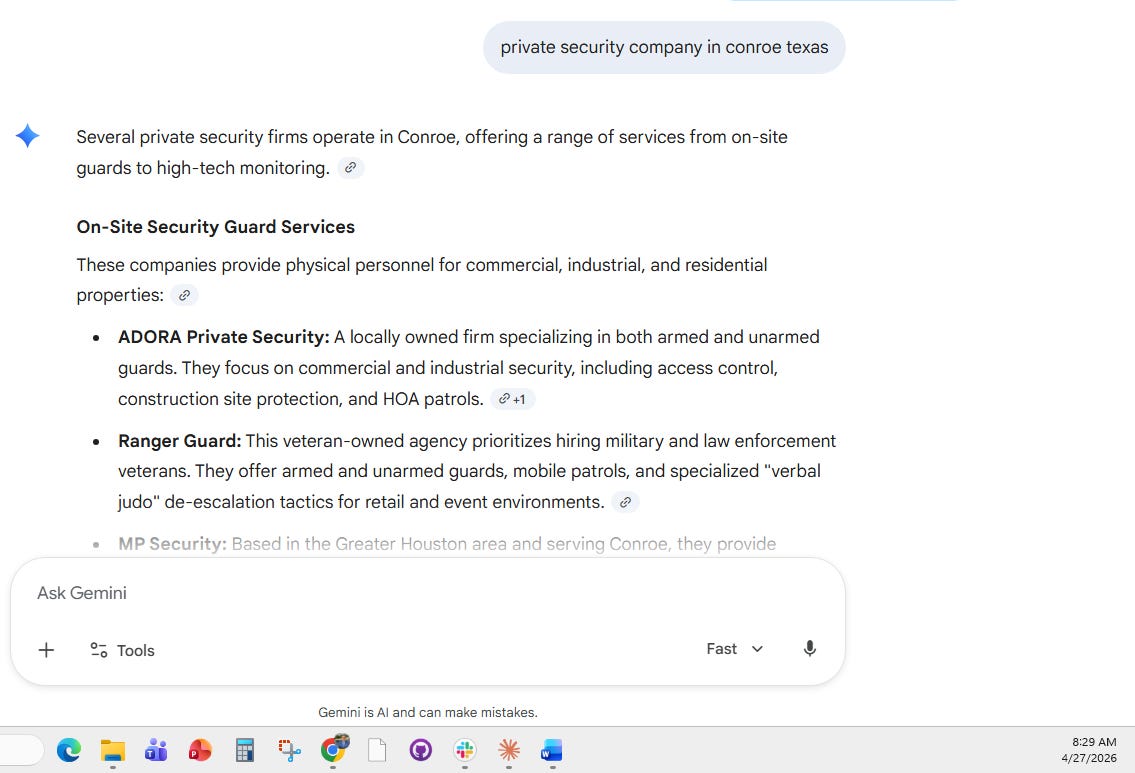
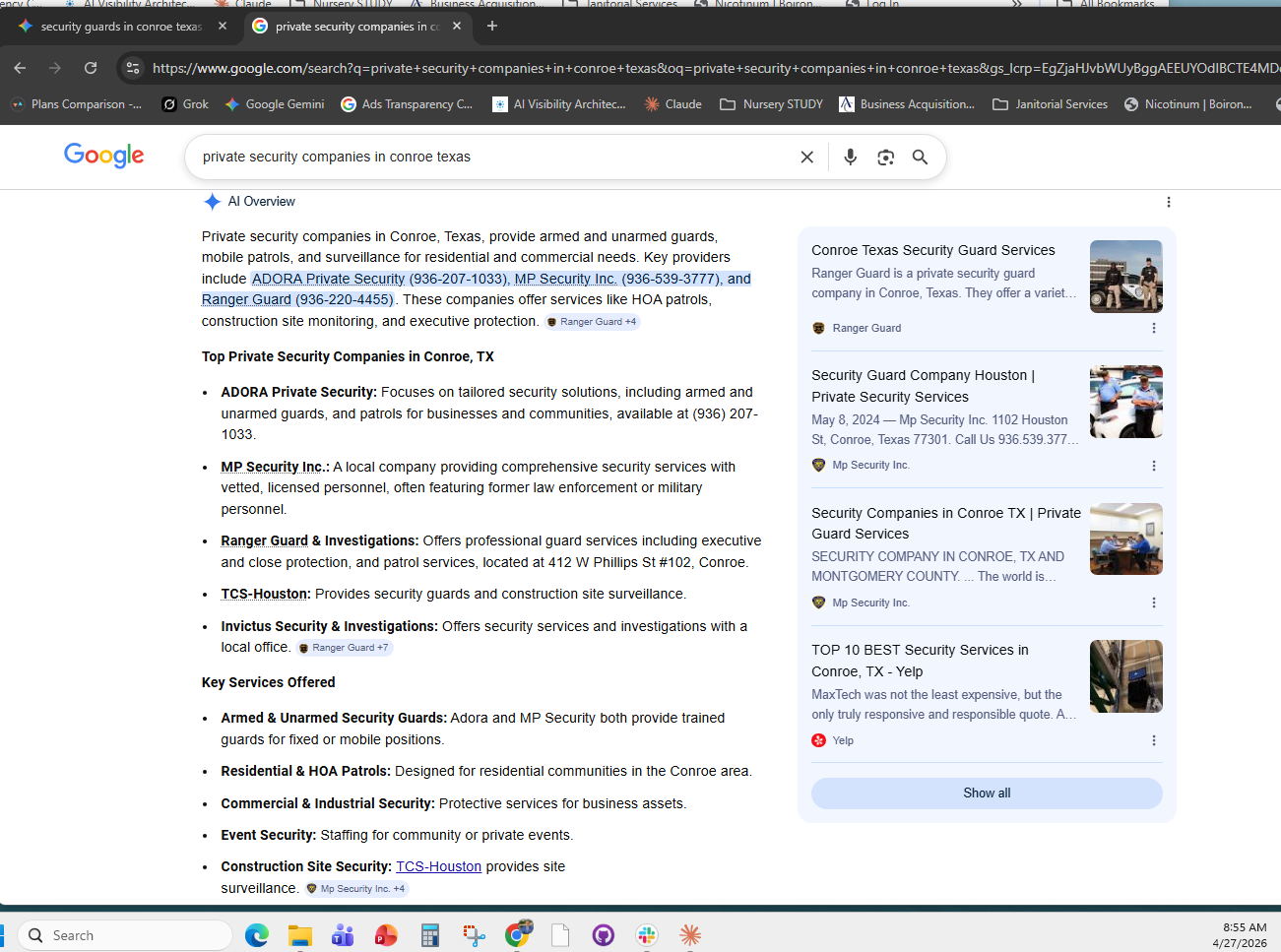
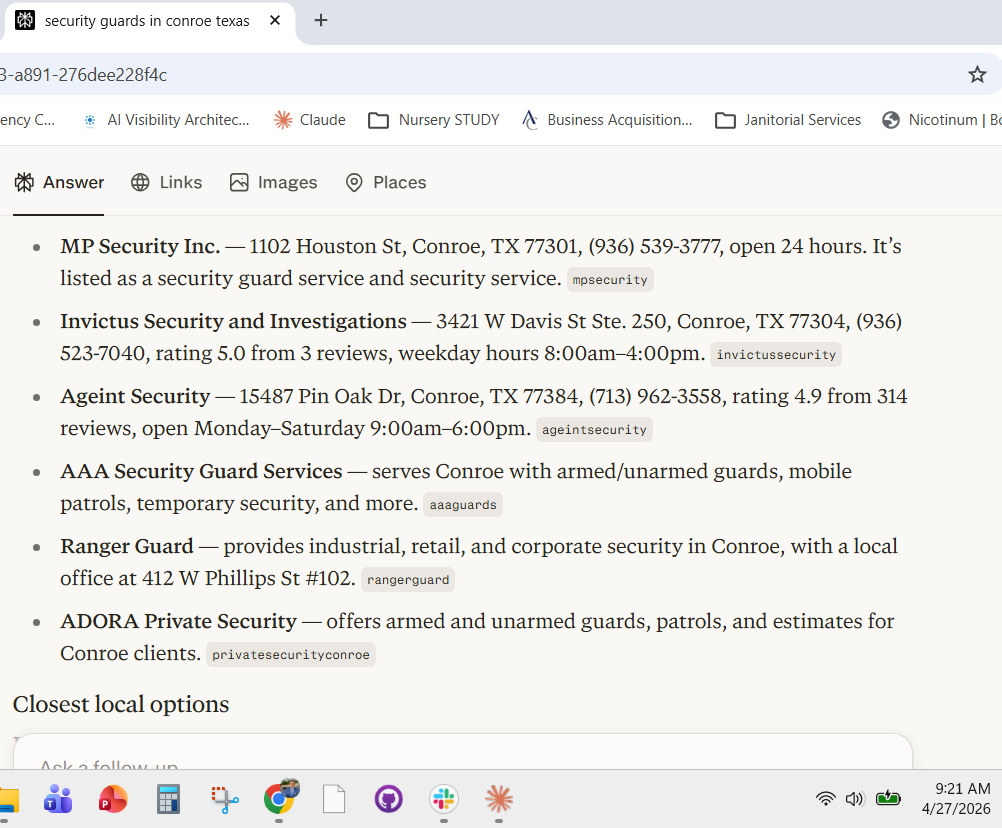
Same query — “private security companies in Conroe, Texas” — across ChatGPT, Gemini, Google AI Overview, and then a separate query for construction security across ChatGPT.
In every single result, the same company appeared first. ADORA Private Security. Armed description. Correct phone number. Accurate service list. Number one recommendation across every major AI engine simultaneously.
ADORA launched in November 2025. Five months ago. They had zero digital presence when we started working together in February 2026. They were competing against Ranger Guard — fifteen years in the market. MP Security — operating since 2003. Established players with hundreds of reviews and years of search authority.
Conventional SEO wisdom said to expect six to twelve months before meaningful results. We documented verifiable AI Overview appearances in 45 days. This morning’s screenshots confirm those results are holding at Day 90.
I’m not writing this to impress you. I’m writing this because most people — including most digital marketing agencies — don’t understand why this happened. And if you don’t understand why it happened, you can’t replicate it. You can only get lucky.
This is the explanation.
The thing most agencies are selling doesn’t exist anymore
For fifteen years the digital marketing industry sold rankings. Position one on Google. Page one for target keywords. Domain authority scores. Traffic numbers.
Those things still matter. But they are no longer sufficient — and in many categories they are no longer even the primary battleground.
When someone opens ChatGPT and types “who should I hire for security in Conroe” they are not looking at a list of ten blue links. They are receiving a recommendation. A synthesized answer from an AI system that has already done the research, evaluated the options, and decided who to name.
The businesses on that recommendation list get the call. The businesses not on it never know the customer was searching.
This is not a future scenario. It is happening right now. According to SOCi’s 2026 Local Visibility Index, 45% of consumers now use AI tools to find local businesses — up from 6% one year ago. Only 1.2% of local businesses currently appear in those recommendations.
The question is not whether AI search is real. The question is why some businesses appear and others don’t — and whether that outcome can be engineered deliberately.
It can. But not with a marketing framework.
How AI systems actually decide who to recommend
This is the part most agencies skip because it requires thinking like an engineer rather than a marketer.
AI systems do not rank businesses the way Google’s traditional algorithm ranks web pages. They build something closer to a confidence score — an assessment of how certain they are that a given entity is real, trustworthy, and accurately described.
That confidence score is built from cross-source validation. AI reads what your website says about you. Then it reads what your Google Business Profile says. Then your Yelp listing, your BBB record, your industry directories, your reviews, your schema markup. It compares all of those sources against each other.
If they agree — if the same name, the same services, the same location, the same description appears consistently across every indexed source — the confidence score rises. AI treats the entity as verified and cites it.
If they disagree — if your website calls you one thing, your GBP calls you something slightly different, your Yelp description is from 2019 and doesn’t match your current services — the confidence score stays low. AI hedges. It may mention you vaguely or not at all.
This is not a marketing problem. It is a verification problem. The same problem I spent twenty years working on in industrial environments — where suppliers had to demonstrate capability, consistency, and compliance across every documented system before they could be qualified.
The parallel is exact.
Why my background produced a different framework
I did not come to digital marketing from marketing.
I spent two decades working in industrial operations, supplier quality management, and engineering support systems across global manufacturing and energy-sector supply chains. My work involved evaluating whether suppliers could be trusted — not by taking their word for it, but by auditing their systems, verifying their documentation, and confirming that what they claimed about themselves matched what every independent record showed.
I held an ASQ Certified Quality Auditor credential. ISO 9001 Lead Auditor certification through Exemplar Global. Safety management credentials through NASP. I worked in environments where a supplier who said one thing on their capability statement and something different in their quality manual was disqualified — not penalized, disqualified — because inconsistency in self-description is the primary indicator of unreliable operations.
When I looked at how AI systems make citation decisions, I recognized the mechanism immediately. AI is running a supplier qualification process on every business it considers recommending. It is asking the same questions a procurement engineer asks:
Who are you? What do you do? Where do you operate? Who has independently confirmed these claims? Do your systems agree with each other?
If the answer to any of those questions is unclear, ambiguous, or inconsistent — you don’t make the list.
The AI Visibility Authority Engine framework I built at Avenity Business Solutions is a supplier qualification framework applied to digital presence. It is not a content marketing strategy. It is not a keyword research system. It is an entity verification and consistency architecture — and it produces results that marketing frameworks cannot because it is solving the right problem.
What we actually built for ADORA
I want to be specific because specificity is what separates engineering from hand-waving.
ADORA Private Security launched with a blank domain, no reviews, no citations, no established presence of any kind. The conventional approach would have been to start blogging, build backlinks, and wait for domain authority to accumulate over twelve months.
We did not do that.
Week 1 — Entity foundation. We defined ADORA’s primary service anchor precisely: licensed private security company in Conroe, TX, specializing in armed and unarmed guards, mobile patrols, construction site security, event security, and HOA patrol. That exact description — same language, same structure — went to every platform simultaneously. Google Business Profile. Bing Places. Apple Business Connect. The website. Not similar language. Identical language. Because AI cross-validates sources against each other, and any variation creates an entity disambiguation failure.
Week 1-2 — NAP consistency. Name, address, and phone number verified character-for-character across every indexed source. TX DPS license number confirmed and placed in schema as a machine-readable credential linked to the issuing body’s public database. One inconsistency — “ADORA Private Security” on one platform and “ADORA Security” on another — breaks the cross-validation chain. We had zero inconsistencies.
Week 2 — Schema markup. Structured data implemented with the correct @type (SecurityGuard under LocalBusiness), hasCredential linking the TX DPS license number to the TOPS public record, FAQPage schema matching the visible FAQ content word-for-word, ContactPoint with 24/7 availability, and sameAs connections linking GBP, Facebook, Yelp, the Chamber listing, and every other indexed profile back to the same organizational @id. Schema does not create trust. It confirms trust that already exists across consistent sources. We confirmed what we had already built.
Ongoing — GBP posting 2x per week without exception. This is the freshness signal most agencies miss. Google’s AI reads active GBP posting as an entity engagement signal. Two posts per week, every week — real photos, primary service context, location language. Not stock images. Not promotional copy. Evidence that the business is real and active.
Ongoing — Review velocity with keyword coaching. We did not just ask for reviews. We coached the language. A review that says “great service” has no AI citation value. A review that says “ADORA’s construction site security team in Conroe responded within 20 minutes and managed access control for our entire build” has high citation value because AI extracts it as confirmation of specific services in a specific location. We coached every review request accordingly.
The result was not magic. It was a systematic sequence executed correctly, in the right order, without shortcuts.
Forty-five days to the first verified AI Overview appearances across ChatGPT and Gemini.
This morning — April 27, 2026, 90 days after we started — I ran the searches again. ADORA is still number one across ChatGPT, Gemini, and Google AI Overview for the same queries. The result is not a snapshot. It is a sustained position built on an entity foundation that compounds over time.
The window that exists right now
ChatGPT’s assessment of our work noted something I want to be direct about: Avenity has early proof but not yet enough public evidence for national-scale dominance. That is an accurate and honest assessment. We have documented results in specific niches — security, wellness, roofing — in specific markets. We do not yet have the breadth of case studies that would justify claiming national dominance.
I am telling you this because I think honesty about what we have built and what we have not built yet is itself a signal of the engineering mindset versus the marketing mindset. Marketers inflate. Engineers document.
What I can tell you honestly is this: the window that currently exists for local and regional service businesses to get into AI Overviews is real and it will not stay open at this level of accessibility indefinitely.
Gemini independently described what we are doing as one of the few boutique Texas firms to have built a repeatable, documented system for Answer Engine Optimization. ChatGPT assessed our framework as addressing the real mechanics — entity clarity, structured capability pages, local authority, consistent signals, and buyer-intent content — not just AI buzzwords.
Those are unsolicited assessments from the same AI systems our clients need to appear in. The framework works because it is built on the right foundations. But the businesses that move now — that build entity integrity, cross-source validation, and structured AI-readable presence while most of their competitors are still treating this as a future concern — will own the recommendation slots.
The ones that wait will find the door harder to open. AI confidence scores are not reset periodically. The businesses that establish verified entity foundations now are compounding that advantage every day. The businesses that wait are allowing competitors to establish the same advantage against them.
What to do right now
If you are a local or regional service business and you want to know whether your business currently appears in AI recommendations for your most valuable queries — the answer takes about five minutes to find.
Open ChatGPT. Type “best [your service] in [your city]” and read what comes back. Then open Gemini and run the same search. Then open Google and search the same query — look for the AI Overview box above the organic results.
If your business appears — good. Note the language AI uses to describe you. That is what it believes about your entity based on your current digital footprint. If the description is wrong, incomplete, or missing key services, that is a signal of entity ambiguity that is costing you citations you should be getting.
If your business does not appear — you now know the problem. Not a rankings problem. Not a content problem. An entity verification and consistency problem that has a systematic solution.
The framework exists. The results are documented. The window is open.
Daniel Katen is the CEO of Avenity Business Solutions in Montgomery, TX. He is the creator of the AI Visibility Authority Engine framework and holds an MBA from the University of Derby, ASQ Certified Quality Auditor (CQA) certification, ISO 9001 Lead Auditor certification through Exemplar Global, and NASP safety management credentials. His 20+ years in industrial operations, supplier quality, and engineering compliance across global manufacturing and energy-sector supply chains shaped a framework that treats AI visibility as a verification problem, not a marketing problem.
ADORA Private Security’s AI Overview results are verifiable in real time. Search “private security companies in Conroe Texas” in ChatGPT, Gemini, or Google AI and see the current recommendation.
Avenity Business Solutions offers a free AI Visibility Audit showing exactly how your business currently appears across ChatGPT, Perplexity, and Google AI — and what it would take to change that.
avenitybusinesssolutions.com · 936-701-0994 · Montgomery, TX